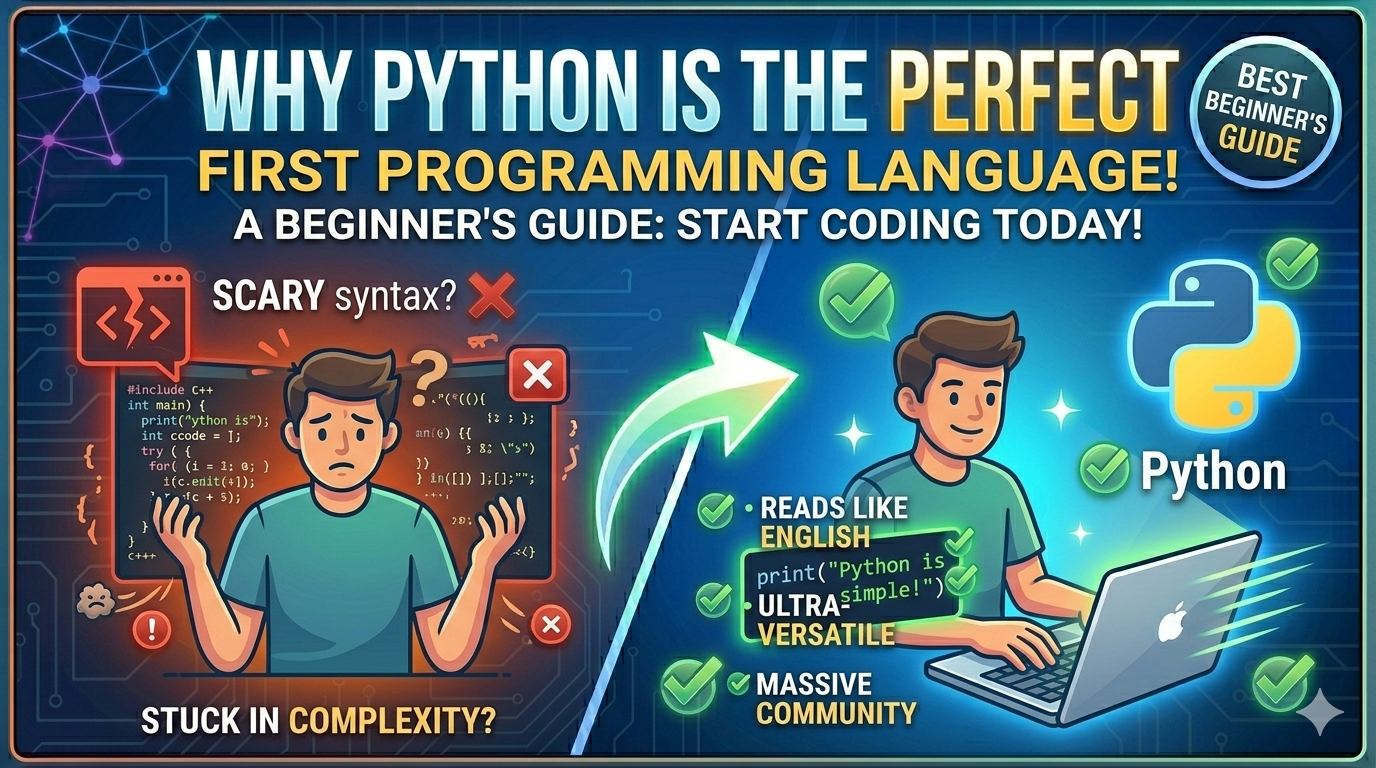
Learning to code can feel incredibly intimidating. If you look over the shoulder of a seasoned software developer, you will likely see a dark screen filled with glowing text, strange brackets, and mathematical symbols that look like an alien language.
It is easy to assume that unless you are a math genius or have a degree in computer science, programming is locked away from you. But that is simply not true. The secret to learning how to code isn’t about being a genius; it is about picking the right starting line.
For the vast majority of people today, the absolute best place to start is Python.
Whether you want to build the next big web application, automate your digital marketing tasks, or just understand how the technology around you works, Python is the ultimate gateway. In this guide, we will break down exactly why Python is the undisputed king of beginner programming languages and show you how to write your very first script in under five minutes.
1. It Reads Like Plain English
The biggest hurdle with older programming languages (like C++ or Java) is their “syntax.” Syntax is the set of grammatical rules you have to follow so the computer understands you. Older languages have strict, unforgiving syntax packed with semicolons and curly brackets. If you miss a single semicolon, the entire program crashes.
Python was intentionally designed by its creator, Guido van Rossum, to be incredibly readable. It prioritizes clean, uncluttered spaces and uses standard English words instead of confusing punctuation.
Let’s look at a practical example. If you want to tell the computer to print the phrase “Hello, World!” on the screen, here is what it looks like in Java:
Java
public class HelloWorld {
    public static void main(String[] args) {
        System.out.println("Hello, World!");
    }
}
That is a lot of confusing jargon just to print two words. Now, here is the exact same command in Python:
Python
print("Hello, World!")
That’s it. No complicated wrappers or confusing brackets. It does exactly what it says it will do. This readability means you spend less time memorizing punctuation and more time actually learning how to solve problems.
2. Insane Versatility: What Can You Actually Build?
Some programming languages are “one-trick ponies,” built specifically to do one thing (like styling a webpage or querying a database). Python is the ultimate Swiss Army knife.
Once you learn the basics of Python, you can apply it to almost any tech discipline in the world. Here are just a few things you can do:
- Automate Boring Tasks: If you manage a digital brand, you can write a Python script that automatically resizes a folder of promotional images, renames them for SEO, and schedules them for your social media feeds.
- Data Analysis & Finance: Instead of manually updating massive Microsoft Excel spreadsheets for a budget or business payout ledger, Python can instantly scrape data, organize it, and generate a visual graph of your finances in seconds.
- Web Development: Some of the largest websites in the world, including Instagram, Spotify, and Netflix, rely heavily on Python to manage their back-end systems.
- Artificial Intelligence: Python is the undisputed language of the AI revolution. If you want to build machine learning models or interact with tools like ChatGPT programmatically, Python is mandatory.
3. A Massive, Welcoming Community
When you are learning to code, you will get stuck. You will write a script, run it, and get an ugly red error message.
Because Python is so popular (it consistently ranks as the #1 or #2 most used language in the world), the internet is overflowing with free resources, tutorials, and forums to help you. If you encounter an error, millions of other beginners have encountered that exact same error before you. A quick Google search will almost always yield a friendly answer on sites like Stack Overflow or Reddit.
Furthermore, Python has a massive ecosystem of “libraries.” A library is a bundle of pre-written code that you can plug into your project for free. If you want to build a video game, you don’t have to code the physics engine from scratch; you just download the free Pygame library. If you want to analyze data, you download the Pandas library. The community has already done the heavy lifting for you.
Your First Lesson: Write Your First Script
You don’t need to download any heavy software to see Python in action. You can run it directly in your web browser right now.
- Open a new tab and go to an online Python compiler like Programiz or Replit.
- You will see a blank text editor. Click inside it and type the following line exactly as it appears:
Python
print("My first Python script!")
- Now, look for the big “Run” or “Play” button on the screen and click it.
- In the output console (usually on the right side or bottom of the screen), you will see the computer speak back to you:
My first Python script!
Congratulations. You just wrote a functional piece of software.
Now, let’s do some math. Delete the first line, type this, and hit Run:
Python
revenue = 5000
expenses = 1200
profit = revenue - expenses

print("Total Profit:")
print(profit)
The computer will instantly output 3800. You have just created a tiny, functional financial calculator!
The Bottom Line
You do not need to be a math prodigy to learn to code. Programming is simply the act of giving a computer a set of logical instructions, and Python is the easiest, most human-friendly way to give those instructions.
By starting with Python, you bypass the frustrating syntax of older languages and immediately start building real, useful tools that can automate your workflow, analyze your data, and launch your digital career.
Leave a Reply